
If you've started looking into furniture store website costs in the UK, you've probably noticed something annoying: nobody gives you a straight number.
One agency quotes £8,000. A freelancer says £2,000. Someone on Facebook offers to do it for £300. So which one is right?
Honestly, they can all be right. The price depends on what your shop needs and, just as much, on who builds it. This guide gives you real price ranges, explains what pushes the cost up or down, and helps you avoid paying for things you don't need.
The Short Answer
Here are typical 2026 price ranges for a UK furniture shop:
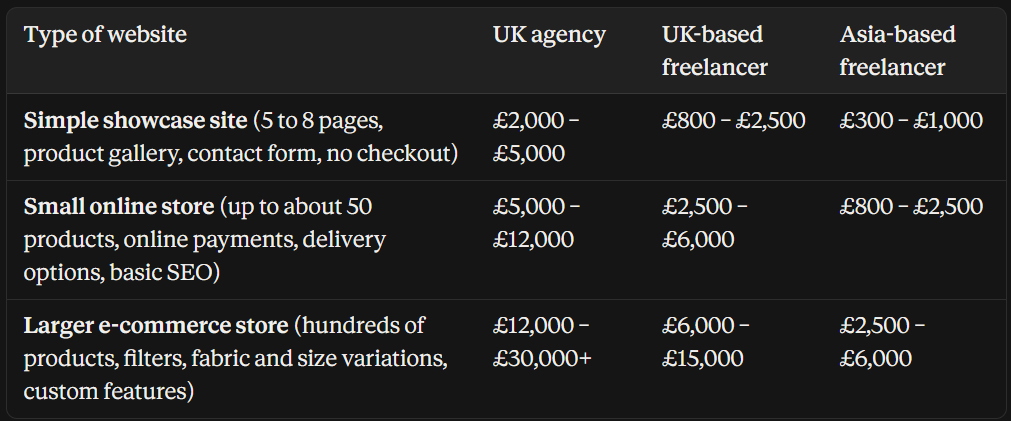
These are general market ranges, not a quote. Your final price depends on the factors below.
Why is the gap so big?
Agencies charge the most because they pay for offices, project managers, designers and sales teams. You get a full team, and you pay for it.
Freelancers have lower overheads, so they usually charge noticeably less for similar work.
Location matters. A freelancer in London or Manchester has UK living costs to cover, so their rates are higher. A freelancer in Asia has lower living costs and can charge less, often with the same technical skills, because the work is done online anyway.
Some shop owners prefer a local agency they can meet face to face. Others care more about getting a fast, well-built website at a fair price. Neither choice is wrong. It depends on your budget and how you like to work.
What Decides the Price?
1. How many products you sell
Ten sofas and a few tables is a very different job from 400 products with several fabrics and sizes. Every product page needs photos, descriptions, variations and prices, and that takes time.
2. Showcase site or full online store
Do customers browse and then call or visit? Or do they pay online? Taking payments means more setup: a payment provider, delivery rules, order emails and a returns policy.
3. Delivery complexity
Furniture isn't like selling T-shirts. Large items need delivery zones, postcode-based pricing, delivery windows and sometimes assembly options. The more complicated your delivery, the more the website costs to build.
4. The platform you choose
Shopify is easy to manage and reliable, but has monthly fees.
WooCommerce (WordPress) is flexible and has no monthly platform fee, but needs good hosting and regular updates.
Custom-built (for example with Next.js) gives you total control and top speed, but costs more and is only worth it if you need something specific.
5. Design, photos and content
Do you already have professional photos, product descriptions and a logo? If not, you'll need to pay for them or create them yourself. Photography matters more for furniture than almost any other retail niche, because customers can't touch the product.
6. SEO and Google setup
A website nobody finds is just an expensive brochure. Proper local SEO (page titles, product page optimisation, Google Business Profile connection and speed work) is either included in better packages or sold as an add-on. Don't skip it. If you want to understand why, read our guide on how furniture stores can get more customers from Google.
The Costs People Forget
The build price is only the start. Budget for these too:
Domain name: roughly £10 – £20 a year
Hosting: from around £5 to £50 a month, depending on platform and traffic
Shopify plan (if you use it): a monthly fee that varies by plan, plus transaction fees
Plugins and apps: some are free, others charge monthly
Payment fees: card providers take a small percentage of each sale
Maintenance: updates, backups and security checks, often sold as a monthly plan
Photography and copywriting: if you need them
Always ask your developer for a full list of ongoing costs before you sign anything. A fair developer will tell you upfront.
Freelancer vs Agency vs DIY Builder
Asia-based freelance developer
The most affordable professional option. Everything happens online through video calls, WhatsApp and email, so you rarely lose anything by not meeting in person. Before hiring, check their portfolio, how fast they reply and how much of your working day you'll overlap.
UK-based freelancer
A good middle ground if you like working with someone in your own time zone and country. Expect higher rates than overseas freelancers.
Agency
Good for large retailers with bigger budgets and complex needs. You get a team, but you also pay for the overhead, and smaller clients can end up as a low priority.
DIY (Wix, Squarespace, Shopify templates)
Cheapest upfront, and fine for a very simple start. The catch is time. Setting it up properly takes many hours, and templates often limit speed, SEO and design. Many owners end up paying a developer later to fix it.
Red Flags When Hiring a Web Developer
Be careful if someone:
Quotes a price without asking about your shop, products or goals
Offers a full online store for a suspiciously low price with no explanation
Won't say who owns the website and domain once it's built (it should be you)
Has no examples, reviews or past work to show
Promises "number one on Google" in a few weeks. Nobody can honestly guarantee that
Locks you into a long hosting or maintenance contract without clear terms
How to Get an Accurate Quote
Before contacting any developer, write a short brief:
How many products do you plan to list?
Do you want online payments, or just an enquiry-based site?
Where do you deliver, and how does pricing work?
Do you have photos, a logo and product descriptions ready?
Are there websites you like as examples?
Do you want help ranking on Google and Google Maps?
With this, a developer can give you a clear fixed quote instead of a vague guess. It saves you both hours of back-and-forth.
Frequently Asked Questions
How much does a Shopify website for a furniture store cost?
For a small shop, roughly £2,500 – £6,000 with a UK freelancer, £800 – £2,500 with an Asia-based freelancer, and £5,000+ with an agency. Add the monthly Shopify plan and any paid apps on top.
Can I build a furniture website for under £1,000?
Yes, if it's a simple showcase site, especially with an overseas freelancer. A full online store at that price from a UK developer usually means cutting corners on design, speed or SEO.
How long does it take to build a furniture store website?
A simple site can take 2 to 3 weeks. A full online store often takes 6 to 10 weeks, depending on how quickly you provide photos and product details.
Do I need SEO for my furniture website?
If you want customers to find you on Google, yes. Furniture is a research-heavy purchase, and good SEO plus a strong Google Business Profile bring in local buyers who are ready to spend.
Who should own my website?
You should. Make sure the domain, hosting accounts and website files are in your name or fully transferable.
So, What Should You Budget?
For a small independent shop, a realistic starting point for a good-quality online store that's fast, mobile-friendly and set up to be found on Google is:
£800 – £2,500 with an Asia-based freelancer
£2,500 – £6,000 with a UK-based freelancer
£5,000+ with an agency
Spend where it matters: good photos, clear delivery information and proper SEO. Skip the fancy extras until sales justify them.
About the Author
I'm Mohammad Awais, a web and mobile software engineer based in Lahore, Pakistan. I build fast, modern, search-friendly websites for businesses, including furniture stores, restaurants and e-commerce shops, using tools like Next.js, React and WordPress. You can see my work, including a furniture store project called Harmonia Furniture, in my portfolio.
I work with UK business owners remotely, which keeps my prices lower than UK agencies and many UK freelancers. I keep everything clear from the start: a fixed quote, no hidden fees, no jargon, and fast replies on WhatsApp or email.
Get a Clear, Fixed Quote for Your Furniture Store Website
Not sure what your shop needs or what it should cost? Tell me a little about your business and I'll reply with an honest recommendation and a fixed price, with no pressure and no obligation.
Prefer a quick chat? Message me on WhatsApp or email contact@awaiscoder.com.